
Kia ora everyone! My name is Dan Borja, and I am a master’s student from the University of Auckland studying entomology. Over the last couple of months, I have been conducting experiments at Matuku Link with the permission of the lovely staff who have given me a very warm welcome to the reserve.
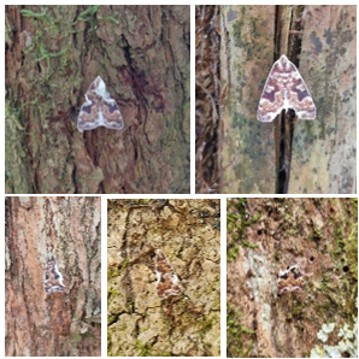
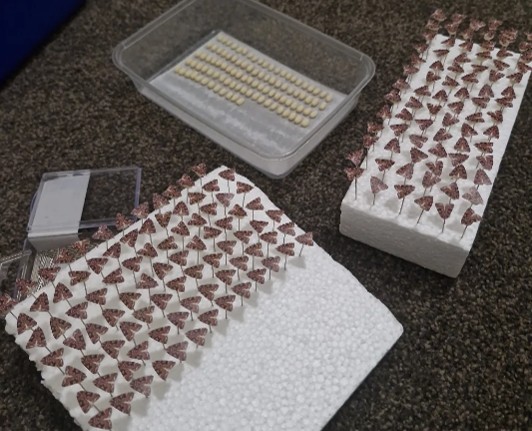
My research stems from psychological studies which demonstrate the importance of symmetry as a tool for quick visual object recognition and identification. In other words, symmetrical objects or patterns tend to be recognised faster than asymmetrical objects. My research aimed to provide evidence for this in animals by looking at how wing patterns of moths are observed by birds. I conducted two experiments at Matuku: one which looks at how wing folding behaviour in moths may disrupt the symmetrical patterns of their wings, and the second experiment which observes how the orientation of a moth at rest may influence the perception of its symmetry. I hypothesised that moths which don’t fold their wings are more predated by birds. This is because the symmetry in moth wing patterns makes them more obvious to predators, especially in the forest as their backgrounds tend to be asymmetrical (making symmetrical patterns stand out!). I also hypothesised that moths which rest vertically are more predated because their symmetry is more obvious compared to moths which rest horizontally or diagonally. To test these hypotheses, I carefully crafted fake moth models out of paper and dough which were edible and harmless to birds and placed them on different trees at Matuku. Over a couple of months, I monitored the survival of these models under bird predation, taking note of which models were eaten sooner than others. I also conducted general bird surveys through 5-minute bird counts to gauge the diversity and frequency of birds at Matuku.
From my results, It seems that one of two scenarios are likely: one is that moths which have extremely folded wings are actually more predated (not what I was predicting!). It could also be that my moths are being affected by stabilising selection pressures. This means that bird predation is higher in moths with perfectly symmetrical and (at the same time) extremely asymmetrical wing patterns. However, this is just a theory, and I will be doing more research to justify my reasoning.

Recent Comments